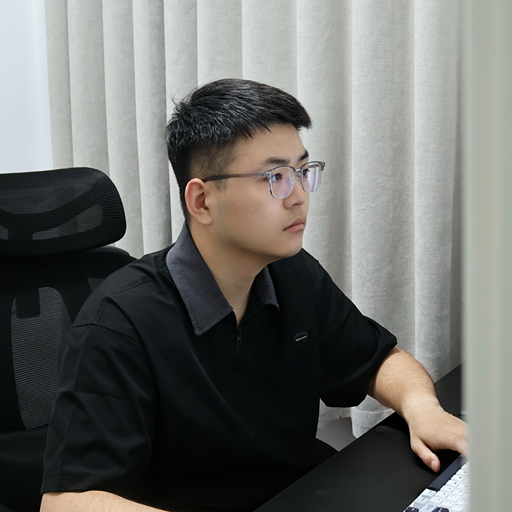
I am a Ph.D. student at the School of Computer Science and Technology, Tongji University, supervised by Prof. Liang Hu (Head of the Collaborative and Intelligent Computing Laboratory). My main research interests include Continual Learning, Machine Unlearning, Brain-inspired AI, and Model Memory Mechanisms, with a focus on exploring and developing innovative methods to enable machine learning models to learn, forget, and manage their own memory in a manner similar to the human brain.
I hold a Master’s degree in Science, majoring in Mathematics, under the supervision of Prof. Feilong Cao at Chian Jiliang University (also thanks to Prof. Hailing Ye at Chian Jiliang University and Prof. Ming Li at Zhejiang Normal University). My academic background combines strong theoretical foundations with practical skills, enabling interdisciplinary research.
I am open to collaborations with researchers and teams sharing interests in Lifelong Learning, aiming to explore novel research directions, exchange ideas, and advance the application of related technologies in practice.
🔥 News
- 2026.05: 🎉🎉 One paper is accepted by IJCAI 2026 (CCF-B).
- 2026.04: 🎉🎉 Visiting the research group of Prof. Longbing Cao at Macquarie University.
- 2026.03: 🎉🎉 One papers is accepted by Environmental Science & Technology (JCR-Q1, 中科院1区Top, IF=12.2, AI for Chemistry/AI4C).
- 2026.01: 🎉🎉 Two papers are accepted by WWW 2026 (CCF-A).
- 2025.12: 🎉🎉 Awarded the First Prize for Outstanding Paper by the Collaborative and Information Services Technical Committee of the Shanghai Computer Society.
- 2025.10: 🎉🎉 Visited the research group of Prof. Xipeng Qiu at Shanghai Innovation Institute.
- 2025.08: 🎉🎉 One paper is accepted by IEEE Transactions on Pattern Analysis and Machine Intelligence (JCR-Q1, 中科院1区Top, CCF-A, IF=20.4).
- 2025.05: 🎉🎉 Built a good academic collaboration with Prof. Usman Naseem’s team at Macquarie University.
- 2024.12: 🎉🎉 Awarded the Excellent Master’s Thesis of Zhejiang Province.
- 2024.10: 🎉🎉 Built a good academic collaboration with Prof. Hongying Zhao’s team at Tongji University.
- 2024.07: 🎉🎉 Built a good academic collaboration with Prof. Longbin Cao’s team at Macquarie University.
- 2023.10: 🎉🎉 One paper is accepted by Pattern Recognition (JCR-Q1, 中科院1区Top, CCF-B).
- 2023.01: 🎉🎉 One paper is accepted by Neural Networks (JCR-Q1, 中科院2区Top, CCF-B).
📝 Publications
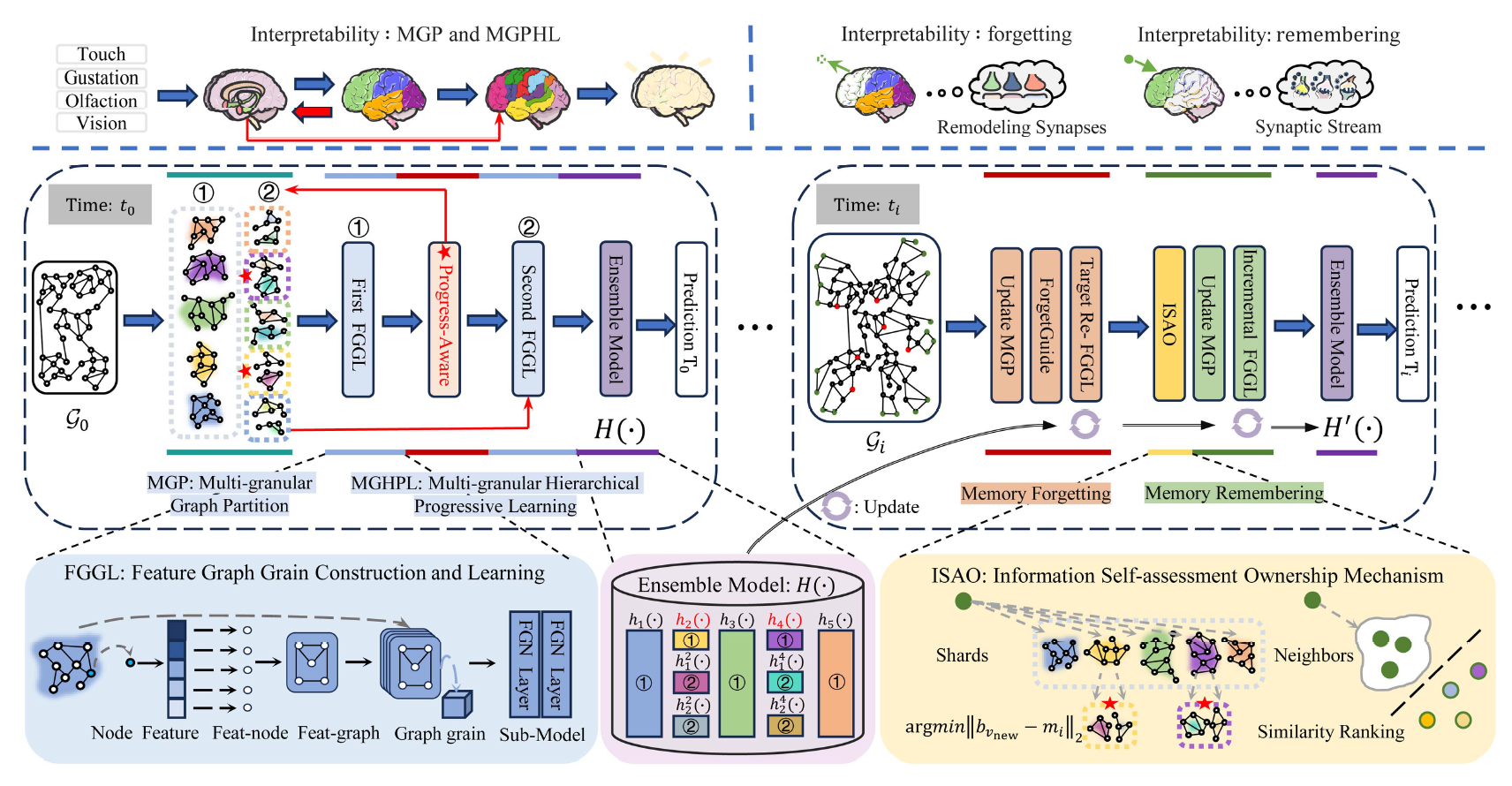
Graph Memory Learning: Imitating Lifelong Remembering and Forgetting of Brain Networks
Jiaxing Miao, Liang Hu, Qi Zhang, Longbin Cao
This paper introduces a new concept of graph memory learning. Its core idea is to enable a graph model to selectively remember new knowledge but forget old knowledge. Building on this idea, the paper presents a novel graph memory learning framework Brain-inspired Graph Memory Learning (BGML), inspired by brain network dynamics and function-structure coupling strategies.
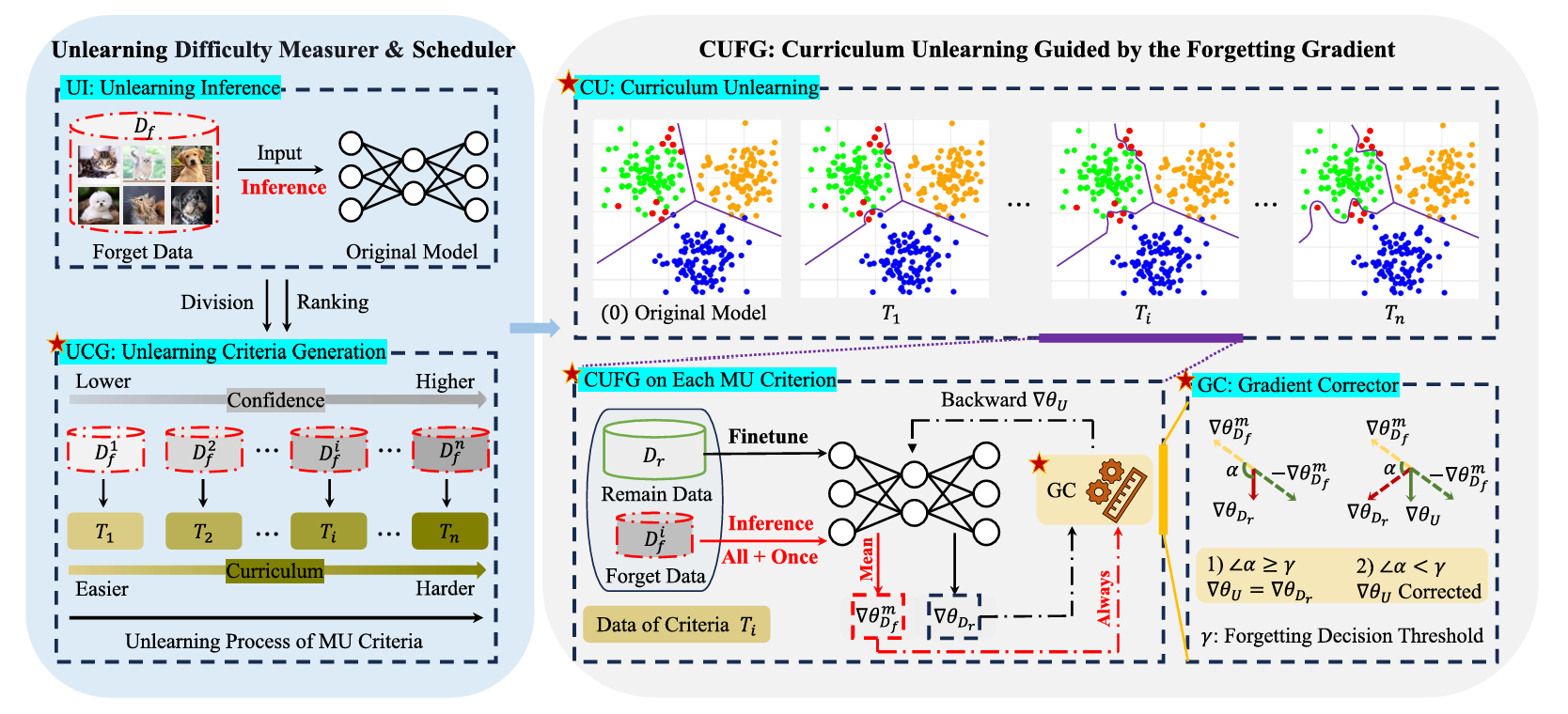
Reliable Curriculum Unlearning via the Right Forgotten Pathway
Jiaxing Miao, Liang Hu, Qi Zhang, Zhongyuan Lai, Tangwei Ye and Usman Naseem
This paper proposes CUFG (Curriculum Unlearning via Forgetting Gradients), a novel framework that enhances the stability of approximate unlearning through innovations in both forgetting mechanisms and data scheduling strategies. Specifically, CUFG integrates a new gradient corrector guided by forgetting gradients for fine-tuning-based unlearning and a curriculum unlearning paradigm that progressively forgets from easy to hard.
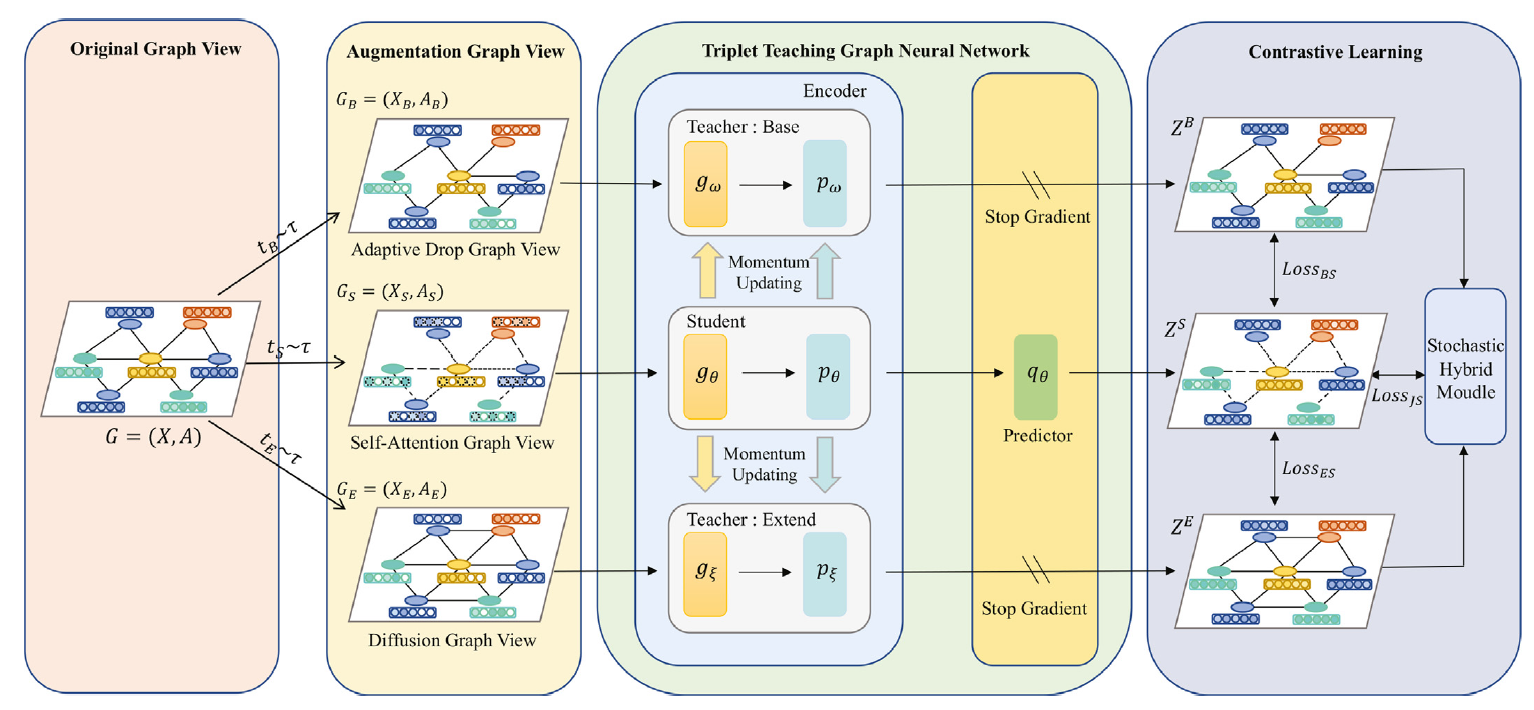
Triplet teaching graph contrastive networks with self-evolving adaptive augmentation
Jiaxing Miao, Feilong Cao, Ming Li, Bing Yang, Hailiang Ye
Building on the teaching concept, this paper proposes a novel triplet-based teaching graph contrastive network with self-evolving adaptive augmentation (T-GCSA). It addresses the critical challenges of generating reasonable augmented views, utilizing them effectively, and constructing efficient, comprehensive contrastive objectives.
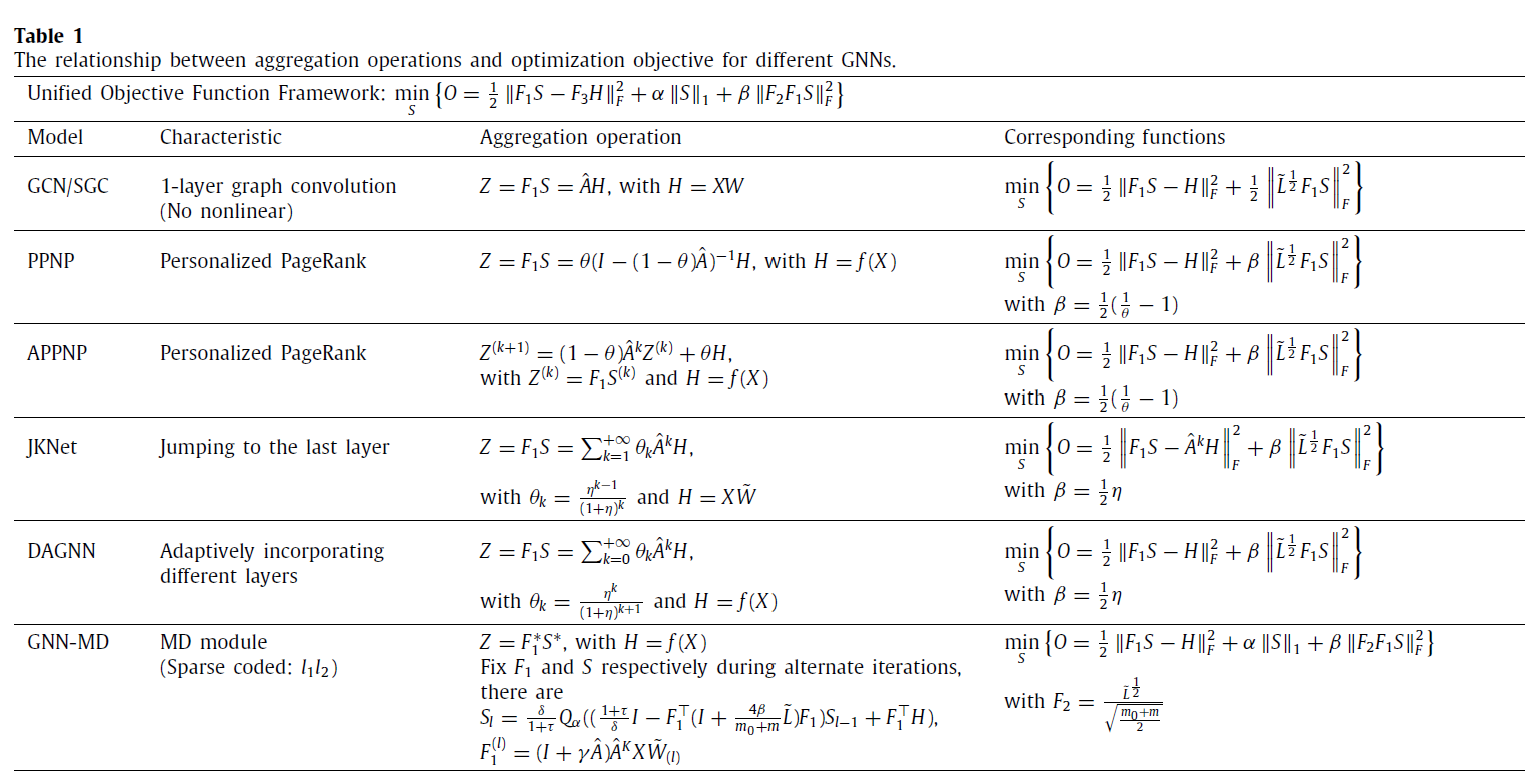
Revisiting graph neural networks from hybrid regularized graph signal reconstruction
Jiaxing Miao, Feilong Cao, Hailiang Ye, Ming Li, Bing Yang,
This paper presents a unified optimization framework from hybrid regularized graph signal reconstruction to establish the connection between the aggregation operations of different GNNs. We use this new framework to mathematically explain several classic GNN models and summarizes their commonalities and differences from a macro perspective. Based on this, we design the new model, GNN based on model-driven and data-driven (GNN-MD). We also theoretically analyze its convergence.
📝 Cooperation Publications
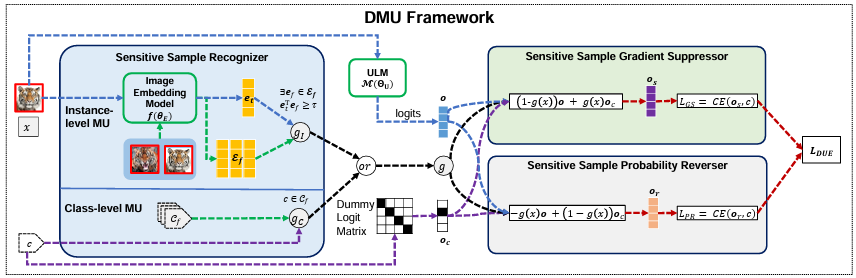
[A Durable Unlearning Enhancement Framework to Nullify Recall of Sensitive Data on Incremental Training]
Qingqing Cao, Liang Hu, Dora Dongmei Liu, Jiaxing Miao, Zhongyuan Lai, Cao Jian, Wei Cao
This work addresses the problem of post-unlearning knowledge recall, where previously forgotten sensitive information can be inadvertently restored during incremental model updates. The proposed Durable Unlearning Enhancement (DUE) framework detects sensitive samples in new data and suppresses their gradients to prevent the re-emergence of unlearned knowledge.
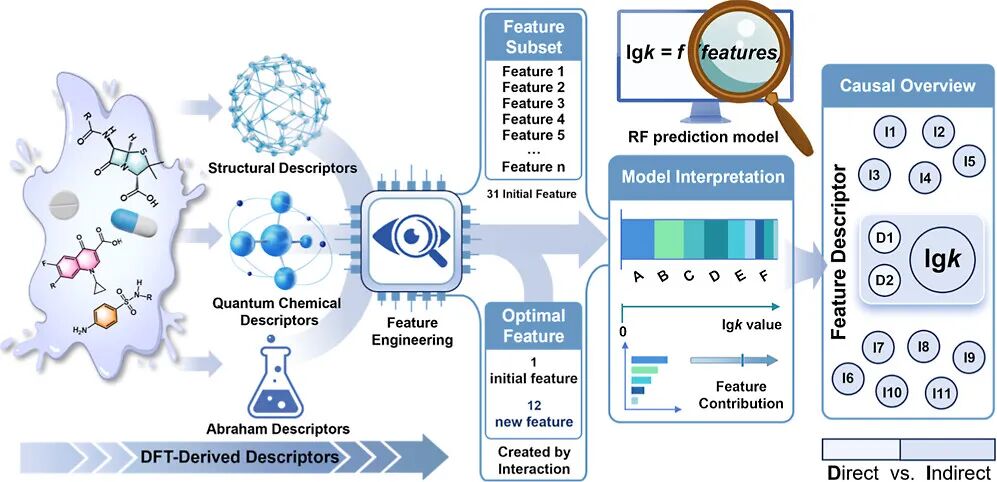
Shihua Zou, Zonglin Li, Yicen Dai, Jiaxing Miao, Zhiyu Zhao, Liang Hu, Hongying Zhao
This work develops an interpretable machine learning framework for AI-driven chemistry to uncover the intrinsic molecular factors governing HO· reactivity with antibiotic pollutants. By integrating DFT descriptors and attention-based features, the model identifies key molecular drivers of reactivity. The causal-interface model uncovers intrinsic cause–effect relationships and enables reliable mechanistic insight.
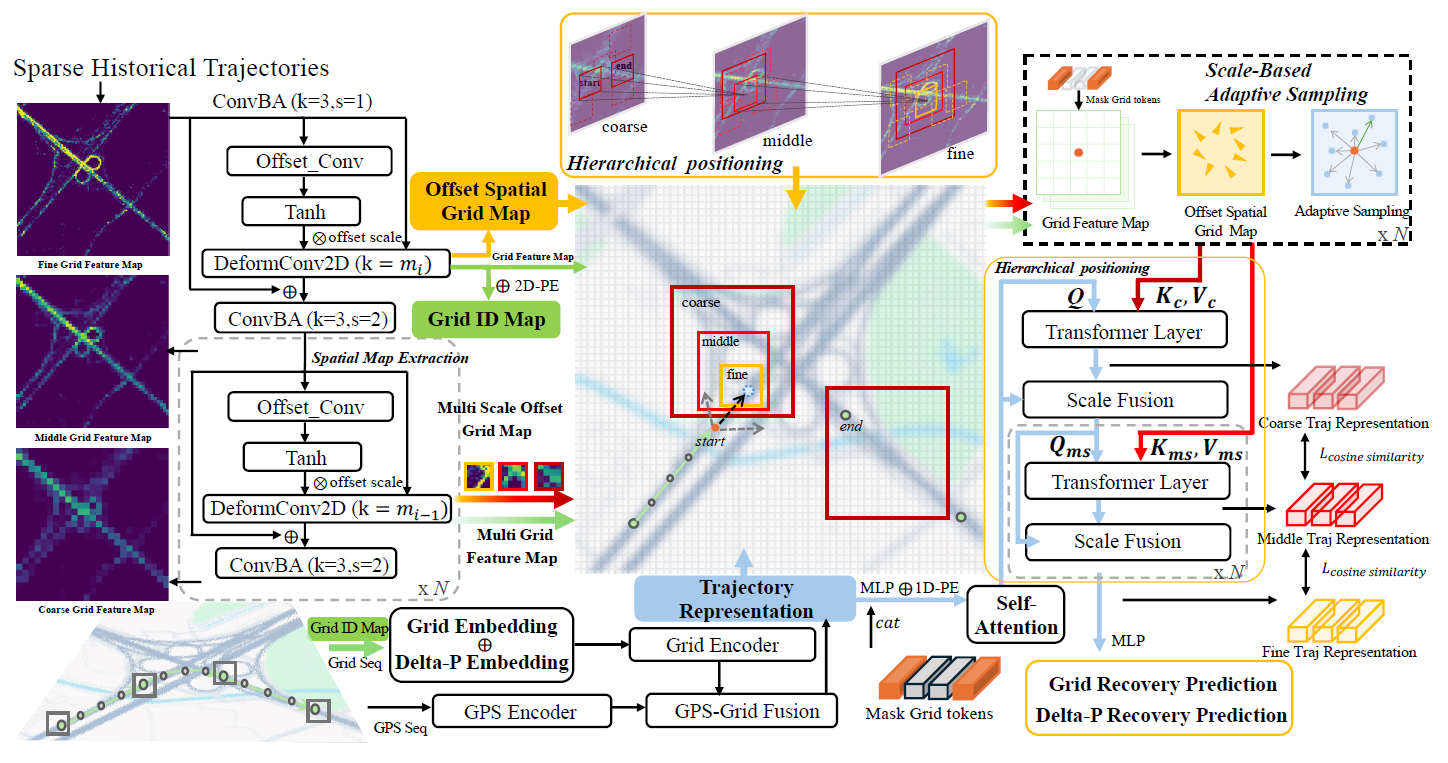
Accurate Trajectory Recovery in Underserved Areas via Location Inference from Web Crowdsourced Data
Tangwei Ye, Liang Hu, Zhongyuan Lai, Qi Zhang, Yiming Wu, Jiaxing Miao, Yijun Yang, Kun Yi
This paper introduces Region-aware Hierarchical Trajectory Recovery (RHTR), a region-aware framework that leverages web crowdsourced data and a coarse-to-fine multi-scale representation to recover trajectories in roadless and data-sparse regions without relying on explicit road networks or reliable GPS signals.
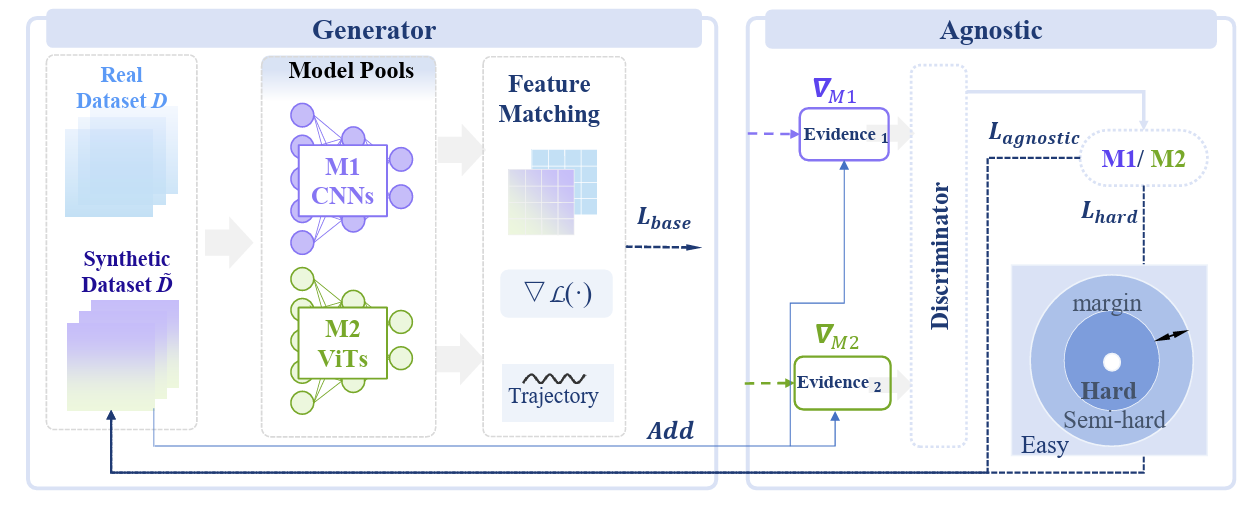
AMID: Model-Agnostic Dataset Distillation by Adversarial Mutual Information Minimization
Aoqi Wu, Junming Liu, Evelyn Zhang, Weiquan Huang, Yifan Yang, Jiaxing Miao, Qi Zhang, Lai Zhong Yuan, Liang Hu
This paper introduces an information-theoretic approach to model-agnostic dataset distillation. It proposes Adversarial Mutual Information Distillation (AMID), which minimizes architectural bias via adversarial learning, enabling strong cross-architecture generalization.
🎖 Honors and Awards
- 2025.12: Awarded the First Prize for Outstanding Paper by the Collaborative and Information Services Technical Committee of the Shanghai Computer Society.
- 2024.12: My master’s thesis titled ‘Interpretable Graph Representation LearningUnder Semi-Supervised and Unsupervised’ was awarded the Excellent Master’s Thesis of Zhejiang Province.
- 2021.12: Won the second prize in the 18th National Graduate Mathematical Modeling Competition in China.
📖 Educations
- 2023.09 - now, Ph.D. student, the Department of Computer Science and Technology, Tongji University, Shanghai 201804, China.
- 2020.09 - 2023.06, Master. the Department of Mathematics, China Jiliang University, Hangzhou 310018, China.
- 2016.09 - 2020.06, Undergraduate. the Department of Mathematics, Zhejiang Ocean University, Zhoushan 316022, China.
💻 Academic Service
- Serving as a reviewer for The 40-th Annual Conference on Neural Information Processing Systems (2026).
- Serving as a reviewer for ACM Multimedia 2026.
- Serving as a PC Member and reviewer for ACM Web Conference 2026.
- Serving as a reviewer for The 39-th Annual Conference on Neural Information Processing Systems (2025).
- Serving as a reviewer for IEEE Transactions on Neural Networks and Learning Systems.